
阿凡达
不想相亲的年轻人,在工会找到了什么?_我的网站

A |
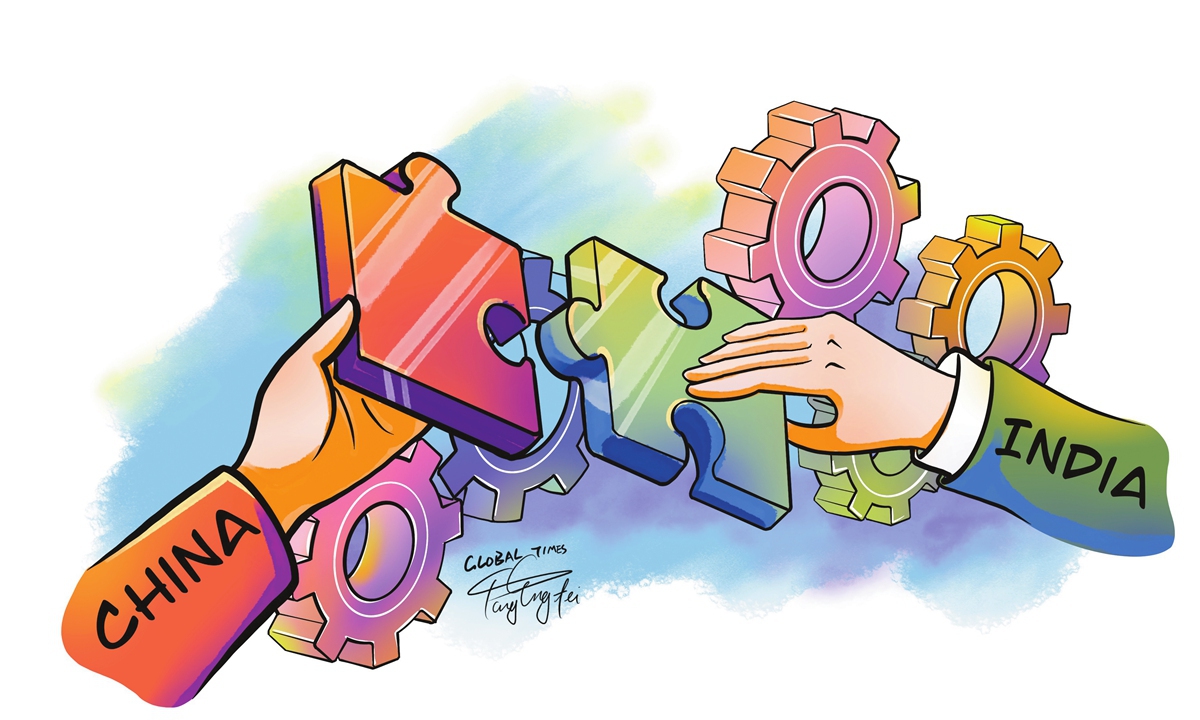
Some Indian media outlets and regional political forces have recently sought to amplify allegations of an unverified China-India border confrontation, while official signals from Beijing and New Delhi have emphasized stability, communication and the importance of managing differences through established mechanisms.
The contrasting narratives have emerged at a moment when exchanges between China and India in various fields have gradually resumed, and cooperation has been advanced in an orderly manner, Chinese experts noted, warning that sensationalizing border-related claims could disrupt the hard-won momentum in bilateral ties and the two countries should prevent the boundary question from hijacking their broader relationship.
Contrasting narratives
The latest media speculation was partly triggered by claims made by the People's Party of the so-called "Arunachal Pradesh" (PPA), a regional Indian political party. According to The Arunachal Times, a local Indian newspaper, a four-member PPA "fact-finding committee" led by former minister and party adviser Kahfa Bengia visited the so-called "Taksing area" (known as Taxin, in Zangnan, Southwest China's Xizang Autonomous Region) on July 10 and subsequently alleged that Indian forces had been prevented from accessing several patrolling points.
The claims were then amplified by Indian news outlet ThePrint, which reported on Tuesday, citing unnamed sources, that Chinese and Indian patrols had allegedly come "face to face" near Taxin in late July.
The outlet further claimed that Chinese personnel subsequently left before returning in early August and setting up "two or three tents."
However, ThePrint acknowledged that sources in India's defense and security establishment said the "situation was well under control."
Some other Indian reports have also questioned the sensational allegations. India Today reported on Wednesday that Indian government sources dismissed social media claims circulating about what was described as "slow encroachment," while noting that similar allegations regarding the area had previously been rejected by local authorities and the Indian Army.
In fact, the claims stand in contrast to the official diplomatic signals coming from both sides.
Asked on Tuesday about reports concerning the border, Indian Ministry of External Affairs spokesperson Randhir Jaiswal said New Delhi takes border matters seriously and reiterated India's position that "the state of the border affairs will reflect on the state of our larger bilateral ties," according to a media briefing released by the ministry on its website on Tuesday.
He also referred to existing mechanisms for dealing with border issues and preventing misunderstanding and miscalculation, according to the briefing.
Responding on Wednesday to questions from Bloomberg and Reuters concerning social media claims about stepped-up Chinese military activity and a possible new border incident, Chinese Foreign Ministry Spokesperson Guo Jiakun said, "The China-India border situation is generally stable at the moment."
"China and India held the 36th meeting of the Working Mechanism for Consultation and Coordination (WMCC) on China-India Border Affairs last week. The two sides agreed to maintain communication via diplomatic and military channels and jointly uphold peace and tranquility in the border areas," Guo said.
Qian Feng, director of the Research Department at Tsinghua University's National Strategy Institute, told the Global Times on Thursday that the fact that the two sides continue to communicate through established channels shows that the border situation has not developed in the direction of escalation portrayed by some Indian media.
Such hype also came amid another development concerning Zangnan. India on August 7 announced what it called "standard" names for 27 locations in so-called "Arunachal Pradesh," a move that some Indian media outlets portrayed as an effort to counter China and further connected with the latest reports of border tensions.
China has firmly rejected the move. Responding to the issue on Monday, spokesperson Guo said, "Zangnan region is China's territory. China does not recognize the so-called 'Arunachal Pradesh' illegally set up by India."
Guo said India's attempt to replace names long used by China with its so-called "standard names" is "illegal, null and void," and stressed that it would not change the fact that Zangnan belongs to China.
Hu Zhiyong, a professor from Zhejiang International Studies University and a research fellow at the Institute of International Relations at the Shanghai Academy of Social Sciences, told the Global Times on Thursday that border and security issues have traditionally been susceptible to political manipulation in India's domestic politics. "When domestic economic and social problems become difficult to address, issues involving the borders with China or Pakistan can easily be pushed to the forefront to divert public attention," Hu explained.
He said economic pressures, concerns over foreign investment and the domestic business environment, together with accumulated public sentiment, could provide incentives for some political forces to magnify external disputes.
Hu argued that another problem lies in the tendency of some Indian political figures to bind the boundary question too closely to the entire China-India relationship. "The boundary issue is one part of bilateral relations, which also encompass political, economic, diplomatic, security and people-to-people exchanges," Hu said. "It should not be allowed to hijack the entire relationship."
Dialogue matters
According to the Chinese Foreign Ministry's statement of the August 6 meeting, the two sides conducted constructive dialogue in a candid and friendly manner, had an in-depth exchange of views on further implementing the consensus reached during the 24th Round of Talks between the Special Representatives of China and India on the Boundary Question, and agreed to jointly prepare for the coming 25th Round of SR talks. The two sides also discussed boundary delimitation, border management, mechanism development, cross-border exchange and cooperation. The two sides agreed to continue to maintain diplomatic and military communication, and jointly safeguard peace and tranquility in the border areas.
Hu pointed out that the timing of the latest speculation is noteworthy, as border issues have at times been used by some forces in India in an attempt to gain leverage ahead of important bilateral interactions.
The 36th WMCC meeting demonstrates that the two sides possess functioning channels through which disagreements can be addressed. This is particularly important as China and India seek to sustain the improvement in relations and prepare for further high-level interactions, said Chinese observers.
"The boundary dispute is a complicated issue left over from history and cannot be resolved overnight," Qian said. "What matters is to keep diplomatic and military communication channels open, promptly handle frontline frictions through established mechanisms, expand people-to-people exchanges and strengthen coordination under multilateral frameworks such as BRICS and the SCO."
。 解码“滨缘”工会品牌十余载温情力量杭州日报讯 “我能接受去工会参加联谊,但不能显得我太刻意去找对象。

B | ”七夕前夕,当不少年轻人忙着计划约会方案时,“滨缘·壹期壹会”第29场活动在西溪湿地的一间茶吧进行。50个年轻人分成5组围坐,面前摆着茶点和待拆的手作材料包。现场没有人说“相亲”两个字,取而代之的是“破冰”“手作”“社交”。这是高新区(滨江)总工会花了十多年摸索出的分寸感——年轻人渴望拓展社交圈,但拒绝被贴上“我在相亲”的标签;他们愿意在周末花一个下午坐在这里,却希望整个过程看起来不那么像一场联谊;他们希望认识更多人,但不希望只是被轮桌交换个人信息。多年来,高新区(滨江)总工会持续运营“滨缘”品牌,打破传统相亲固有模式,以暖心服务搭建松弛友好的社交空间,用持之以恒的陪伴为青年职工筑造心灵港湾。困在两点一线里的年轻人程序员唐江洪的生活轨迹简单得近乎刻板:公司、出租屋两点一线,社交圈几乎被同事填满。

C | 为了打破这种固化的生活动线,他在滨江工会的公众号上看到“滨缘”活动时,就抱着“找对象”的朴素愿望报了名。

D | 两场活动下来,他没有遇到心动女生,却依然打算继续报名。

E | “找到对象之前应该都会来,最起码能认识一些新朋友。”对比线上交友软件,他更偏爱“滨缘”的线下模式,“面对面更有真实感,认识的人也感觉更靠谱。”这个想法恰好契合了“滨缘”的初衷,它首先解决的不是婚恋问题,而是社交断层问题。

F | 于滢也是抱着类似目的来的——“多认识一些同在滨江或周边的朋友,下班后可以约着一起玩。

G | ”她是做项目管理的,算是工会联谊活动的“资深参与者”,参加过好几场街道工会和市总工会组织的联谊活动。记者发现,现在很多年轻人并不是在挑剔活动形式,而是在寻找一种“不尴尬”的社交可能。

H | 而“不尴尬”,恰恰是工会做联谊最难拿捏的分寸。“去相亲化”的社交解法“滨缘”并非凭空而来。高新区(滨江)的青年职工基数庞大,互联网、平台企业及产业园区青年高度集聚,普遍工作节奏快、加班频次高,日常社交圈层相对封闭固化。“他们有强烈的交友、婚恋现实需求,但长期缺乏安全正规、有官方背书的纯粹社交渠道。” 高新区(滨江)总工会基层和保障工作条线负责人任聪说,“滨缘”和其他交友方式最大的不同是“靠谱”——工会主办,报名信息经过审核,人员背景相对透明。早在2014年,滨江工会就推出了两天一晚的“周末去哪里”单身青年联谊品牌,2022年整合精品短时联谊活动,打造了“壹期壹会”子品牌。

I | 2025年,联谊服务体系整合升级,统一为“滨缘”品牌,与“滨派”“滨超”等系列品牌共同组成服务职工矩阵。今年以来,“滨缘”已开展各类联谊活动50余场,服务企业59家,参与职工2200余人。数据之外,真正让工会费心琢磨的是另一个问题:如何让联谊显得不像联谊?工会把联谊活动拆解成了一场场“去相亲化”的社交。在“壹期壹会”的现场,撕纸成圈、看图猜台词、心愿纸飞机、非遗台灯手作……这些环节的设计都用游戏降低防御,用手作制造独处,用轮桌保证覆盖面。而在“周末去哪里”的两天一晚活动中,工会把青年带到区外,以草坪嬉戏破冰相识,以古街漫步慢慢相知。蒋佳宁和“那个他”就是这样慢慢熟悉起来的。两人分到同一组,大巴上挨着坐,之后几轮分组又巧合地在一起。

J | 活动结束后的“心动互选”,彼此确认了心意。现在两人都在滨江,日常聊天、约饭、玩剧本杀,关系延续得很自然。据悉,“滨缘”下一步的重点是在标准化、精准化、常态化上持续升级。任聪表示,他们想做的,不只是促成姻缘,更重要的是让扎根滨江的年轻人感受到工会的温度、城市的温度。
Current article:http://9x3.xiaqingzhuangdaminnan.cyou/news/20260826_471182.html
Published on:03:57:40


